Commercial elevators operate in environments where passenger movement can change dramatically throughout the day. An office may experience intense morning and evening traffic, a retail property may have continuous visitor movement, while a mixed-use development can require different traffic patterns on different floors.
For this reason, selecting a Commercial Elevator Manufacturer in Bangalore involves more than deciding how many people a cabin can carry.
Start With Building Traffic
Elevator planning should reflect how the property will actually function.
Important factors include:
- Number of floors
- Expected building occupancy
- Peak-hour passenger volumes
- Number of elevator stops
- Type of occupants
- Accessibility requirements
- Operating hours
- Movement of equipment or goods
- Future occupancy changes
A lift suitable for a small commercial building may be inadequate for a busy multi-storey office property even when both buildings have a similar number of floors.
Capacity and Traffic Handling Are Connected
Capacity describes how much load an elevator can accommodate. Traffic handling considers how effectively the elevator system moves people through the building.
This distinction matters.
Installing one high-capacity elevator does not automatically provide better passenger movement than a properly planned combination of elevators.
Developers and consultants should therefore consider expected waiting times, peak traffic periods, number of lifts, speed, travel distance, and passenger distribution.
Identify Different Passenger Groups
Commercial properties often serve several groups at once.
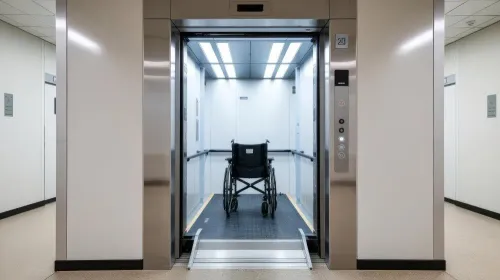
An office development may need to accommodate employees, visitors, maintenance personnel, delivery teams, and people with mobility requirements.
A healthcare-related commercial building may have additional accessibility considerations. A retail property may experience families carrying shopping bags or using mobility aids.
Understanding these groups helps establish practical cabin and entrance requirements.
Plan Elevator Placement Carefully
Elevator location influences how people move through the property.
Ideally, lifts should be easy to locate from major entrances and logically connected to circulation routes. Poorly positioned elevators can cause congestion even when the equipment itself has adequate capacity.
Architects should also consider lobby dimensions because passengers need enough space to wait without blocking corridors, entrances, or other building functions.
Consider Durability in High-Use Environments
Commercial elevators generally experience more frequent use than home elevators.
Cabin materials, flooring, control fixtures, doors, and other high-contact components should therefore be selected with durability and maintenance in mind.
Premium finishes may still be appropriate, particularly in corporate or hospitality environments, but they should be suitable for the expected traffic.
Ask About Operational Continuity
An elevator becoming unavailable can significantly affect a multi-storey commercial property.
Facility managers and developers should evaluate maintenance arrangements before procurement.
Useful questions include:
- What preventive maintenance is recommended?
- How is service support handled in Bengaluru?
- What information is provided to facility teams?
- How are replacement components managed?
- What procedures apply when technical attention is required?
Orchid Elevators works with commercial elevator applications in Bengaluru, where office developments and other business properties can have substantially different traffic requirements.
Consider Future Building Use
Commercial properties can change over time.
A building initially occupied by a smaller workforce may later reach higher occupancy. Floor layouts may change, tenants may be replaced, and visitor numbers may increase.
Elevator planning should therefore avoid focusing only on minimum current requirements where future use can reasonably be anticipated.
For Bengaluru developers, architects, facility managers, and procurement teams, effective commercial elevator planning begins with people and movement. Capacity, speed, number of elevators, placement, durability, accessibility, and maintenance all contribute to the final performance of the vertical transportation system.
Keywords