A lift that feels comfortable at home depends on more than its cabin finish or passenger rating. You need to match the car dimensions, travel pattern, building structure, power supply, approvals, maintenance access, and monsoon protection to the way your household actually moves between floors.
Key takeaways
- Size capacity for passengers, groceries, water cans, cylinders, and furniture.
- Compare hydraulic, traction, and machine-room-less lifts against your shaft space.
- Request survey drawings, safety records, warranty terms, and emergency procedures.
- Test stopping accuracy, door movement, backup power, and rescue access before acceptance.
Will a residential elevator fit your household and daily routine?
A residential elevator in Tumkur fits your routine only when the car, doors, shaft, power supply, and stopping accuracy match the people and items you actually move. Check the rated home lift capacity as the maximum combined weight of passengers, groceries, water cans, oxygen cylinders, or furniture—not as a suggested average.
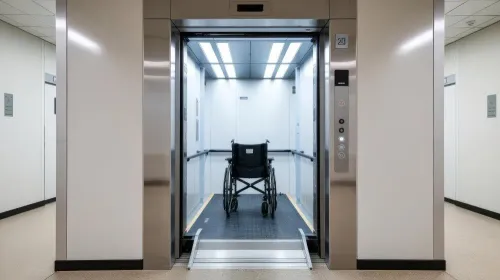
- Measure the wheelchair, walking aid, pram, or shopping trolley you will use. Confirm the clear door opening, usable car length and width, handrail position, control height, turning or reversing space, level floor stopping, audible and visual indicators, and two-way emergency communication. A nominal four-person car can still be unusable for a wheelchair.
- Obtain a general-arrangement drawing showing shaft width and depth, pit depth, overhead clearance, machine-room or controller space, ventilation, maintenance access, structural load paths, and main electrical supply. “Machine-room-less” does not mean space-free.
- Ask whether the house needs slab cutting, plumbing relocation, drainage protection, or extra electrical capacity. Confirm who services Tumkur and how quickly a trapped passenger receives help.
- If a bed or stretcher must enter, specify its full envelope, attendant space, door width, floor loading, washable finishes, ventilation, and emergency requirements. A higher passenger rating does not create a hospital lift.
| Option | Best fit | Check before choosing |
|---|---|---|
| Residential elevator | Multiple floors, wheelchair-accessible lift dimensions, regular goods movement | Pit, overhead, shaft and power |
| Stairlift | One seated user on an existing stair | It cannot carry a wheelchair or several people |
| Platform lift | Wheelchair travel over short rises | Weather protection, travel height and space |
| Dumbwaiter | Groceries or goods only | Never use it for passengers |
| Stair modification | Users who can climb safely | It fails when mobility is the problem |
Which lift type and shaft arrangement suit your Tumkur home?
Choose the lift and shaft arrangement together: a good mechanism can become impractical if the pit, overhead, counterweight, drainage, or access route does not fit your Tumkur home.
| Type | Strength | Check before choosing |
|---|---|---|
| Hydraulic home elevator | Suits low-rise travel and layouts without a counterweight | Reserve space for the pump unit, hydraulic lines, oil containment, pit waterproofing, and power used while raising the car |
| Traction elevator | Efficient for frequent travel and avoids hydraulic oil | Provide overhead clearance, counterweight space, suitable structural supports, and vibration isolation |
| Machine-room-less lift | Saves a separate machine room | “Machine-room-less” does not mean space-free: the motor, controller, ventilation, access equipment, and maintenance clearances must appear on the approved general-arrangement drawing |
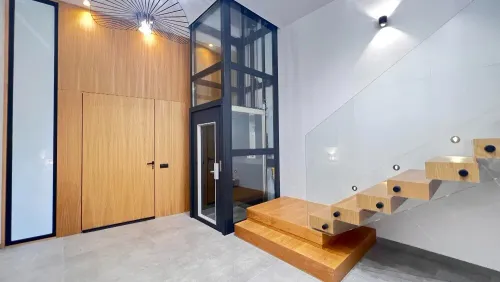
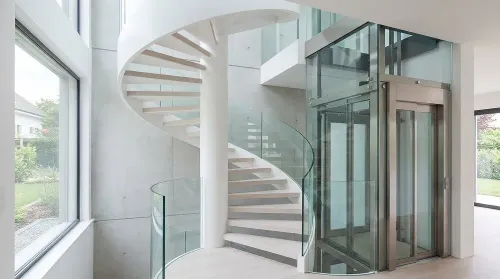
A shaft inside the house protects the equipment from rain and simplifies daily access, but it consumes floor area and can require cutting slabs or moving plumbing.
A shaft beside an exterior wall preserves rooms; an external elevator tower avoids major internal alterations, yet needs a weatherproof enclosure, foundation, landing access, and a safe route between tower and house.
Ask the surveyor to record pit depth, overhead clearance, shaft dimensions, structural load paths, electrical-supply location, delivery access, rainwater exposure, and drainage. Do not accept an open drain that can backflow into the pit.
For one level and a wheelchair route, a platform lift may suit better; for split-level stairs, consider a stairlift. Neither replaces a full lift for groceries, multiple floors, or a wheelchair user who cannot transfer. A dumbwaiter carries goods, not people.
What happens during a residential lift site survey and installation?
The lift site survey Tumkur visit should end with a measured drawing, not a verbal estimate. Record shaft width and length, lift pit depth, overhead clearance, travel between floors, load-bearing walls, slab condition, access for delivery vehicles, water exposure, and the main electrical-supply location. Retrofitting can require cutting slabs or relocating plumbing and wiring.
Coordinate the work in this order:
- Confirm the shaft, landing openings, machine-room or controller location, structural load paths, and whether walls and slabs need strengthening.
- Plan lift installation civil work: excavation, pit waterproofing, shaft construction, landing doors, lintels, finishes, and safe temporary barriers.
- Provide protected pit drainage or a pump with backflow protection. Do not connect the shaft to an open drain that can flood it during monsoon rain.
- Reserve the correct electrical circuit, earthing, isolator, lighting, emergency supply, and battery rescue system. Rescue lowering is not the same as running the lift from a generator.
- Schedule equipment delivery from Bengaluru around road access, gate width, stair access, storage space, and protection of finished floors.
- Install rails, machine or hydraulic equipment, car, doors, controls, alarms, and emergency communications, then test alignment, levelling, noise, and door safety.
- Restore cut slabs, tiles, paint, plumbing, and waterproofing before handover; obtain inspection and operating approval from Karnataka’s electrical-safety authority.
| Option | Main coordination burden | Typical risk |
|---|---|---|
| New construction | Build the shaft and pit before finishes | Incorrect dimensions delay every trade |
| Existing house | Cut slabs and reroute services | Hidden beams, pipes, or wiring cause redesign |
| Monsoon-exposed site | Waterproofing, drainage, and pump protection | Pit water damages equipment and creates shock hazards |
Which approvals, safety records, and contract terms should you verify?
Do not commission the lift on the installer’s certificate alone. Confirm the current Karnataka lift approval, registration, inspection, and lift operating permit process with the Electrical Inspectorate Karnataka, and obtain written evidence that your Tumakuru installation has passed the required inspection.
Ask the supplier to provide these records for the actual lift, not a similar model:
- Approved general-arrangement drawing showing shaft, pit, overhead, access clearances, rated load, speed, and power supply
- Installation and commissioning certificate with the lift serial number
- Test or conformity documents for door interlocks, safety gear, overspeed governor, buffers, emergency alarm, car-top controls, and final-limit switches
- Electrical test results, earthing records, and emergency-rescue instructions
- Inspection approval, registration record, and lift operating permit before regular use
Check whether Orchid Elevators will coordinate the authority submission and attend inspection in Tumakuru, or whether those tasks remain yours. Put the answer in the contract.
Compare promises in writing rather than accepting “lifetime support”:
| Contract item | Ask for | Warning sign |
|---|---|---|
| Warranty | Covered parts, labour, travel, exclusions, response time, and start date | Warranty begins before handover or excludes major safety parts |
| Maintenance | Visits per year, included consumables, breakdown response, rescue attendance, and renewal price | “Free service” has no visit schedule or response time |
| Residential elevator maintenance contract | Service scope, uptime target, call-out charges, spare-part rates, and cancellation terms | No written schedule, escalation route, or parts pricing |
A warranty is not a maintenance contract. Keep both documents with the permit and inspection record.
Related products
 | Residential Elevator Orchid Elevators is a leading home elevator manufacturer in Bangalore, offering innovative elevator solutions that enhance accessibility,... View product → |
 | Residential Elevator Orchid Elevators is a trusted home elevator manufacturer in Bangalore, delivering premium residential elevator solutions that combine accessibility,... View product → |
How do you test comfort, emergency readiness, and lifetime cost?
At handover, a lift acceptance test should prove more than cabin appearance. Ride it empty and loaded: check smooth acceleration, braking, floor levelling, door reversal, noise, vibration, lighting, ventilation, alarm, and two-way communication. Confirm the car cannot move with a landing door open.
- Ask for test records for door locks, safety gear, overspeed governor, buffers, final-limit devices, car-top controls, and emergency alarm.
- Test lift power failure rescue from more than one floor. Confirm the automatic rescue device reaches a suitable landing, releases passengers safely, and operates after the specified number of rescue cycles.
- Ask what happens when the rescue battery is flat; an automatic rescue device is not an inverter or generator for normal lift operation.
- Record standby power, lighting load, ventilation use, battery charging, expected trips per day, and replacement-parts pricing.
- Get a written elevator preventive maintenance scope, visit frequency, response time, rescue attendance, consumables, and battery-replacement responsibility.
After handover, log failed rescues, door faults, unusual sounds, levelling errors, and repeated trips. A quiet lift that begins stopping above the landing needs service before a child or wheelchair user encounters the fault.
Compare the full lifetime cost, not motor horsepower: include civil works, power protection, earthing, testing, waterproofing, communication, statutory fees, and making-good. During a fire, follow the building’s evacuation procedure and use protected stairs unless the lift was specifically designed and approved for evacuation.
Frequently asked questions
How do I know whether a residential elevator fits my household?
Assess who uses the lift, the loads you carry, available shaft space, door position, stopping points, power supply, and daily travel pattern. Rate capacity for the combined weight of passengers and items such as groceries, water cans, oxygen cylinders, or furniture.
Which residential lift type suits a Tumkur home?
Compare hydraulic, traction, and machine-room-less systems by available shaft arrangement, pit and overhead requirements, travel height, noise, energy use, maintenance access, and backup-power needs. The best option depends on the building layout and how frequently you use the lift.
What happens during a residential elevator site survey and installation?
The installer measures floor-to-floor heights, shaft dimensions, pit depth, overhead clearance, door openings, structural supports, electrical supply, and access for materials. You should receive arrangement drawings before civil work, followed by installation, testing, commissioning, and handover records.
Which documents and tests should I verify before accepting the lift?
Ask for the applicable licence or approval records, equipment specifications, warranty terms, maintenance scope, emergency rescue procedure, inspection records, and service contacts. Test ride comfort, levelling accuracy, door reversal, alarm, lights, communication, backup power, and access to rescue controls.
Related product
 | Residential Elevator Orchid Elevators is a leading villa elevator manufacturer in Bangalore, offering premium elevator solutions designed to enhance luxury, convenience,... View product → |