A six-passenger label does not tell you whether a lift will fit your building, handle its busiest period, or meet Karnataka’s approval requirements. By checking the rated load, traffic demand, shaft dimensions, accessibility, site conditions and handover documents, you can decide whether a six-passenger elevator is suitable for your Tumkur property and compare quotations on equal terms.
Key takeaways
- Confirm the rated capacity in kilograms, not only the passenger count.
- Match elevator speed and size to floors, occupants and peak traffic.
- Verify shaft, cabin and door dimensions before construction begins.
- Request Karnataka approvals and a clear long-term service plan.
What “Six Passenger” Means in Kilograms and Daily Use
A 6 passenger elevator rated at 408 kg carries 408 kg in total, not six people regardless of their size. The figure comes from the conventional calculation of 68 kg per passenger, so the phrase “six passenger lift capacity” is only useful when it is tied to a kilogram rating on the nameplate and contract.
Treat 408 kg elevator as a maximum operating load, not a target for every trip. Six adults with bags, a delivery trolley, or building materials can reach the limit quickly; an overload device should prevent movement rather than allow repeated overloading.
Ask for the rated load, clear cabin dimensions, door opening and duty classification in writing.
For a small apartment block, villa development or low-occupancy office, this capacity is often adequate when peak traffic is light and residents do not share one lift at shift or school-run times.
A commercial property needs closer scrutiny because frequent starts, heavier loads and repeated door cycles increase demand even if the passenger count looks modest.
Use these checks before choosing the size:
- Count regular occupants and floors.
- Estimate the busiest five-minute traffic period.
- Set a waiting-time target for that period.
- Check whether cleaners, suppliers or tenants will move loaded trolleys.
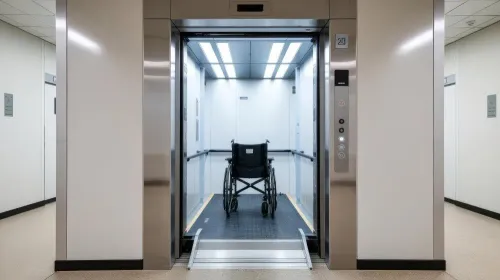
A six-passenger car is not a hospital lift. A wheelchair user also needs a suitable clear doorway, turning space and accessible controls; passenger count alone proves none of these.
Match the Lift to Floors, Occupants and Peak Traffic
Measure the busiest five minutes, not the building’s average usage. A six-passenger lift can suit a small apartment block or low-occupancy office, yet create long queues in a larger commercial property with the same number of floors.
Base the apartment elevator selection or commercial elevator traffic calculation on:
- Total residents, staff, visitors and expected occupancy
- Number of floors and travel height
- Apartments or workspaces served on each landing
- Peak five-minute demand: the number of people arriving for lift service during the busiest five-minute period
- Lift speed, door opening time, loading time and expected round-trip time
- Your acceptable lift waiting time at the busiest landing
Ask the lift designer to model how many passengers the car can move during that five-minute period. The result should show average and worst-case lift waiting time, cars returning to the main entrance, and queue length at peak periods. A model that only states “six passengers” has not answered the traffic question.
For apartments, test the morning school-and-work departure period, evening return period and delivery traffic. For commercial buildings, test arrival at opening time, lunch movement, visitor peaks and trolley use; repeated starts and door cycles demand a higher-duty specification.
If the calculation shows sustained queues, choose a larger car, higher speed, additional lift or traffic-controlled operation. Do not solve a peak-demand failure by reducing the rated load: overcrowding slows boarding and increases waiting for everyone.
Check the Shaft, Cabin and Door Measurements Before Construction
A drawing that shows only the shaft outline is not enough. Before construction, record the elevator cabin dimensions, elevator door width, shaft dimensions, pit depth and overhead clearance supplied for the selected model; generic online tables can leave guide rails, landing doors or maintenance access unusable.
Ask the lift contractor to mark these items on the Tumkur building plan:
- Finished shaft internal size, wall thickness, guide-rail support points and landing-door openings
- Pit depth, waterproofing, drainage route, sump or pump, and protection for electrical equipment
- Overhead clearance, machine-room or machine-room-less equipment space, access route and rescue access
- Power supply, generator connection, automatic rescue device and the floors served during backup operation
| Lift-system choice | Confirm on the plan | Main consequence |
|---|---|---|
| Machine-room-less traction | Shaft top, overhead, rail supports and maintenance access | No separate machine room, but it still needs headroom and safe servicing |
| Hydraulic | Cylinder location, pit arrangement, pump-room space and drainage | Useful where speed is modest, but oil equipment and water management need space |
| Traction with machine room | Shaft, overhead, machine-room size and access | Adds a room and structural coordination above or beside the shaft |
Do not treat a sump as a substitute for waterproof construction. Water in the pit can corrode rails, damage safety equipment and make rescue hazardous.
A six-passenger car can carry a wheelchair, stroller or trolley only if the clear door opening, internal turning space, level accuracy, handrails and control reach work together. A stretcher usually needs a longer cabin or through-opening; verify the stretcher size and loading direction before ordering.
Compare Traction, Hydraulic and Larger Passenger Models
A six-passenger lift is usually the practical middle ground for a small apartment block, villa block or low-occupancy office, but not automatically for every commercial property. Specify the rated load in kilograms—commonly 408 kg at 68 kg per passenger—alongside cabin dimensions, door width, speed and duty classification.
| Model or system | Best fit | Choose another option when |
|---|---|---|
| 4-passenger | A villa or very small residential building with light, irregular use | A wheelchair, stroller, goods trolley or several users must enter together |
| 6-passenger | A residential passenger lift for a small apartment block or low-occupancy office | Peak five-minute demand, occupant numbers or waiting-time targets exceed its traffic calculation |
| 8-passenger | A busier apartment building, clinic or commercial passenger lift needing more simultaneous users | Shaft space, budget or low traffic makes the extra cabin capacity wasteful |
| 10-passenger | A larger commercial building, higher population or frequent trolley use | The building cannot provide the larger shaft, pit, overhead clearance and door arrangement |
| Traction system | Several floors, frequent trips and higher speed requirements | A low-rise building has difficult shaft constraints and light traffic |
| Hydraulic system | Low-rise installation where lower speed is acceptable and machine placement suits the site | Frequent use makes oil heat, leakage control and slower travel costly |
For an 8 passenger elevator comparison, do not compare passenger labels alone. Check peak five-minute demand, travel height, expected waiting time and accessibility measurements such as clear door opening, turning space, handrails and control-panel reach.
The traction elevator versus hydraulic elevator decision also affects maintenance: hydraulic equipment needs oil-leak inspection, heat management and pit protection. A 408 kg six-passenger car is not a hospital lift; beds, attendants and medical equipment require a substantially larger car and doorway.
Plan Tumkur Installation, Karnataka Approvals and Long-Term Service
Do not accept handover until the owner knows who secured the operating permission, inspection and records for the Tumkur elevator installation. Get written confirmation of the Tumakuru lift approval route from the installer and the state electrical-inspection office; do not treat an installer’s commissioning certificate as permission to operate.
1. Check the site before final payment: verify shaft dimensions, pit depth, overhead clearance, landing alignment, machine-room access, permanent power, earthing, fire access and pit waterproofing. Require a drainage and water-management plan; a sump pump does not replace waterproof construction.
2. Collect the statutory file: sanctioned lift drawings, equipment details, wiring and earthing test results, the inspection application, inspection report, approval or licence, and the name and inspection date of the Karnataka lift inspector. Ask which document must remain displayed at the installation.
3. Require signed commissioning records identifying the rated load, speed and car dimensions, with test results for the overspeed governor, safety gear, buffers, door locks, emergency alarm, intercom, manual rescue and emergency lowering. The contract should name IS 14665 elevator standard provisions, or the newer standard adopted for the project, and state the acceptance limits.
4. Put service promises in writing: response time for entrapment, Tumakuru coverage, preventive-maintenance visits, spare-parts availability, lead times for controllers and door parts, warranty exclusions, and the procedure for independent safety inspection. Orchid Elevators should answer these points in the same schedule, not only in a brochure.
Related products
 | Commercial Elevator Orchid Elevators is a leading Commercial Elevator Manufacturer in Bangalore, delivering innovative and high-performance elevator solutions for... View product → |
 | Residential Elevator Orchid Elevators is a leading home elevator manufacturer in Bangalore, offering innovative elevator solutions that enhance accessibility,... View product → |
Frequently asked questions
What does a six-passenger elevator rated at 408 kg mean?
It carries a total rated load of 408 kg, based on the conventional calculation of 68 kg per passenger. The nameplate and contract capacity matter more than the passenger label.
How should you match an elevator to a building’s floors and traffic?
Assess the number of floors, occupants, apartment count and peak periods. Buildings with heavier morning and evening traffic need suitable speed, capacity and operating controls.
What measurements must you check before constructing the elevator shaft?
Confirm the shaft width and depth, pit depth, overhead clearance, cabin size, door opening and machine-room requirements with the lift supplier before construction.
How do traction and hydraulic elevators differ?
Traction elevators suit taller buildings and frequent travel, while hydraulic systems can suit lower-rise properties where space and installation conditions support them. Compare energy use, travel height, pit needs and maintenance.
What should you plan for elevator installation in Tumkur?
Confirm Karnataka approval requirements, electrical and structural readiness, installation access, testing documents and a written maintenance and response plan.