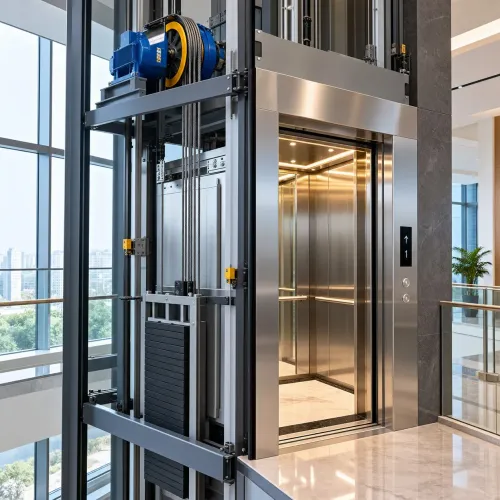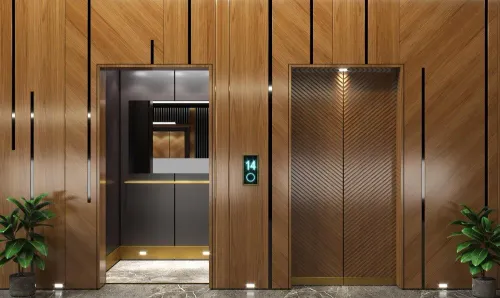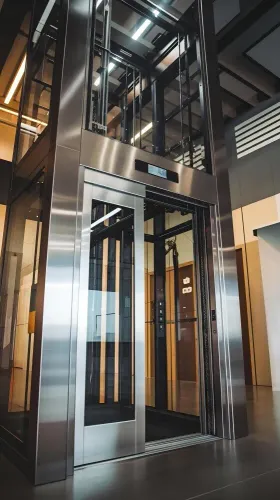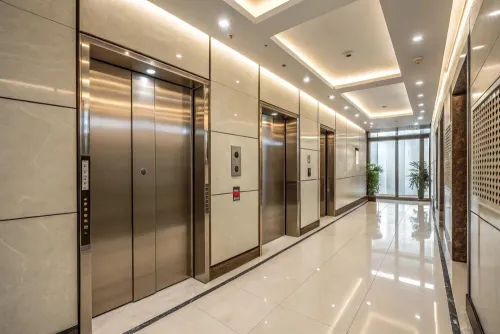
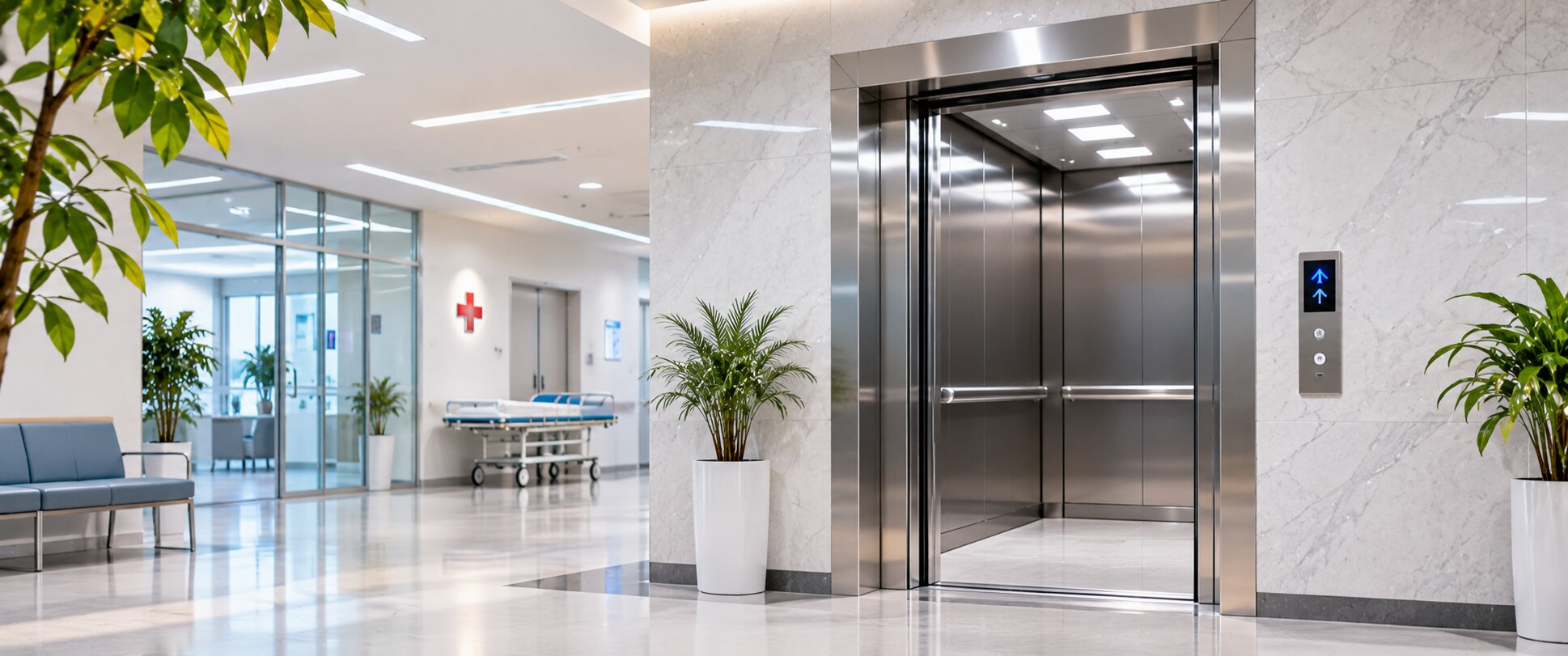
A patient transfer can lose more time at the lift doors, crowded landings, and competing calls than during the actual ride. By measuring each part of the trip and testing the hospital’s busiest routes, you can identify whether the elevator, the surrounding workflow, or both are responsible—and specify fixes that work during outages and peak demand.
Key takeaways
- Measure call, door, loading, travel, unloading, and return-to-service time separately.
- Check bed dimensions, door dwell settings, dispatch logic, and peak transfer queues.
- Separate patient, public, service, and emergency traffic before adding elevator capacity.
- Demand response times, rescue procedures, logs, and preventive maintenance records in the contract.
Where the delay really occurs in a hospital elevator cycle
A high rated speed does not prevent hospital elevator delays in Bengaluru when most time is spent outside the hoistway. The cycle begins with a nurse or porter call, dispatch, car arrival, door opening, bed and equipment loading, door dwell, travel, unloading, and return to service.
A transfer takes longer than passenger travel because staff must position a bed, IV pole, oxygen, monitors, and attendants while preserving turning clearance. Insufficient car capacity, stretcher dimensions, or a narrow clear opening can force repositioning before the doors close.
The car may then travel a long route between emergency, theatres, ICU, radiology, wards, and service floors, stopping repeatedly for other calls.
- A crowded landing brings visitors, staff, wheelchairs, beds, food carts, laundry, and waste into the same space.
- Someone entering after the closing signal triggers a door reversal, extending dwell and delaying every following call.
- Emergency priority can move one patient quickly while leaving routine transfers waiting.
- A small car may require separate equipment movements, making it unavailable for longer.
These effects explain hospital elevator for patient transfer delays in Bengaluru: availability and cycle time matter more than rated speed. Faster travel cannot recover minutes lost to loading, excessive door dwell, repeated reversals, or landing congestion. Measure the full round trip, not only the car’s floor-to-floor speed.
How to measure a delay before blaming the lift
Prove the elevator caused the delay only after separating each transfer into timestamped stages. For hospital elevator for patient transfer delays in Bengaluru, sample normal periods and five-minute or fifteen-minute peak intervals, then log every movement from nurse or porter call to destination.
- Record call registration, car arrival, door opening, completed loading, door dwell, each reversal, travel start and arrival, unloading completion, and the moment the car returns to service.
- Mark failed calls, out-of-service periods, poor leveling, re-leveling, fire recall, and power changeover interruptions.
- Calculate car availability, the number of calls served before the patient reaches the destination, and the percentage of trips missing the hospital’s target transfer window.
Compare the elevator record with the surrounding process:
| Source | Timestamp or observation | What it proves |
|---|---|---|
| Elevator controller | Calls, dispatch, travel, faults | Car response and movement |
| CCTV and porter log | Loading, reversals, unloading, corridor waits | Landing and transfer activity |
| Nurse or ward record | Bed preparation and discharge paperwork | Clinical readiness |
| Imaging and security log | Queue entry, access checks, fire-door interlock release | Non-elevator restrictions |
A long call-to-arrival interval points to the car or dispatch. A long loading interval points to bed preparation, porter availability, equipment, or landing congestion. Also record imaging queues, security checks, corridor congestion, and fire-door interlocks; the bottleneck may sit outside the lift.
What Bengaluru hospitals must check at peak transfer points
Assess the building from movement data, not bed count. Map origins and destinations between the emergency department, operating theatres, intensive-care units, radiology, inpatient wards, kitchens, linen rooms, waste areas, and service floors, then record concurrent transfers in five- or fifteen-minute peaks. Model the same demand with one lift unavailable.
- Compare car length and width, clear door opening, rated load, turning space, handrails, bumper protection, non-slip flooring, cleanable surfaces, lighting, ventilation, door timing, leveling accuracy, and control-panel placement.
- Test the actual bed or trolley with IV poles, oxygen cylinders, monitors, and the required staff. Confirm that everyone can turn, load, unload, and clear the doorway without blocking it.
- Check whether public and clinical traffic share a landing, whether food and waste carts cross patient routes, and whether a breakdown forces staff to use an unsuitable alternative.
| Assessment | What to compare | Failure exposed |
|---|---|---|
| Empty-car demonstration | Empty car versus loaded bed, equipment, and staff | False capacity and door-dwell assumptions |
| Passenger count | People per trip versus simultaneous clinical movements | Underestimated peak demand |
| Shared landing | Public, staff, patient, food, linen, and waste routes | Boarding conflicts and blocked approaches |
| One-car-out test | Full demand with one car unavailable | No viable backup during breakdown |
A car that appears spacious can still create patient lift problems in Bengaluru if the bed cannot turn, the sill is out of level, or access controls delay a clinical call. Record repeated re-leveling, door reversals, and whether the alternative route preserves safe patient movement.
How controls, traffic separation, and backup capacity reduce transfer conflicts
Dedicated bed cars or scheduled transfer windows reduce conflict when emergency, ICU, theatre, and radiology movements peak together. Separate landing zones and controlled staff entrances keep visitors, wheelchairs, food carts, linen, and waste from entering the clinical queue. Destination dispatch groups compatible calls; it does not create capacity.
A priority call or emergency mode can divert every car, lengthening scheduled transfers elsewhere.
Use written rules:
- Authorise priority mode only for defined clinical emergencies; record who activated it, cancel it after the transfer, and release the car to normal group control.
- Position call buttons outside trolley paths, use door-light curtains, set dwell time for bed loading, and prevent late boarding after the closing signal.
- Keep attendants behind a protected staff entrance where possible, and close the transfer zone before the car is called.
- Test generator capacity, automatic-transfer sequencing, essential-supply circuits, and each lift’s start priority with several cars operating.
- Provide a non-stair route for patients during fire recall, then define who permits movement under firefighter operation.
| Design | Main resilience | Remaining risk |
|---|---|---|
| Single lift | Simple control and lower maintenance scope | Any fault, recall, inspection, or power event removes the route; patients may need a longer alternative path |
| Two or more lifts | One car can be isolated for maintenance while others serve transfers | One-car-out demand can still overload the group unless dispatch zones and generator priority are tested |
These are practical hospital elevator solutions in bengaluru only when peak transfer time and one-car-out performance meet the measured target.
What to demand before installation, modernization, or a service contract
Set acceptance numbers before approving medical elevator installation in Bengaluru: a measured transfer target, maximum call-response time, door dwell, transit time, minimum availability, one-car-out performance, and restoration target. “Smooth operation” and rated speed are not evidence.
Require a witnessed test using:
- The real bed or trolley, IV poles, oxygen equipment, monitors, and required staff count
- The access-control sequence, generator changeover, fire recall, emergency communication, normal operation, and degraded modes
- Stopping accuracy at every landing under relevant loads, plus records for door operators, locks, rollers, sill tracks, leveling sensors, overload faults, and entrapment response
Make the service contract measurable.
| Service term | Evidence to require | Failure consequence |
|---|---|---|
| Acknowledgement and attendance | Separate maximum times for remote acknowledgement and on-site arrival | A fault cannot sit unowned |
| Critical spares | Named stock for door, lock, roller, sensor, and controller parts | Repeat failures wait for shipping |
| Fault handling | Remote logging, entrapment escalation, escalation contacts, and restoration deadline | A trapped patient or disabled car has a defined response |
| Planned work | Shutdown notice period and approved outage plan | Clinical transfers are not surprised |
Give Orchid Elevators and every competing Bengaluru supplier identical traffic data and the same test script. Compare proposed car dimensions, controls, power arrangement, outage plan, and measured results, including one-car-out performance—not a generic claim or rated speed. For modernization, demand before-and-after figures for transfer time, availability, and recovery.
Related product
 | Commercial Elevator Orchid Elevators is a leading Hospital Elevator Manufacturer in Bangalore, providing specialized elevator solutions designed to meet the demanding... View product → |
Frequently asked questions
Where do hospital elevator delays occur during patient transfer?
Delays occur across the full cycle: calling the elevator, dispatch, car arrival, door opening, bed and equipment loading, door dwell, travel, unloading, and return to service. Loading, unloading, and shared traffic often consume more time than hoistway travel.
How can a hospital measure elevator delays before blaming the lift?
Record timestamps for the call, car arrival, door opening, loading completion, departure, floor arrival, unloading completion, and return to service. Compare these intervals during peak transfer periods to identify the actual bottleneck.
What should Bengaluru hospitals check at peak patient transfer points?
Check queue length, bed and equipment clearances, door dwell time, dispatch performance, corridor congestion, transfer schedules, and whether public or service traffic conflicts with patient movement.
How do controls, traffic separation, and backup capacity reduce transfer conflicts?
Destination-control or group-dispatch settings can reduce unnecessary stops, while dedicated patient-transfer routes separate beds from visitors and service loads. A backup elevator or defined contingency route protects transfers during faults and maintenance.
What should hospitals demand before elevator installation, modernization, or a service contract?
Require documented bed and equipment dimensions, traffic calculations, control logic, door settings, testing procedures, fault-response times, rescue arrangements, maintenance scope, service logs, and clear uptime and escalation commitments.
Keywords