Choosing a traction lift in Tumkur requires more than counting floors: travel height, passenger demand, shaft dimensions, power quality, weather exposure, and emergency operation all affect the specification. By the end, you will be able to compare traction arrangements, size the car, request the right documents, and test the installation before acceptance.
Key takeaways
- Choose traction for multi-storey buildings with regular passenger traffic.
- Specify car capacity from people, equipment and peak traffic—not floor count alone.
- Protect the drive from voltage variation, heat, dust and water ingress.
- Request safety-chain test records, maintenance logs and named compliance documents.
How a traction elevator moves the car
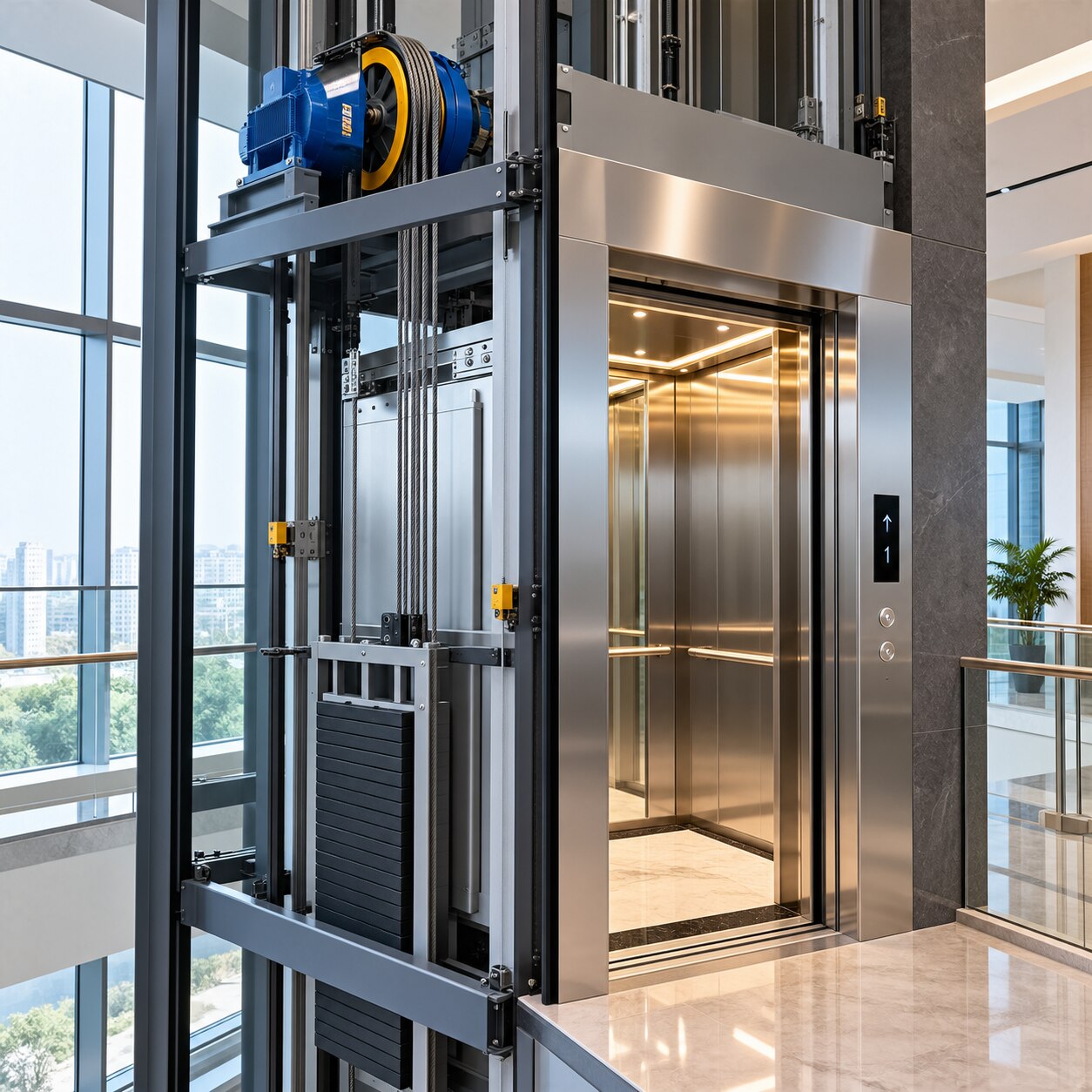
An electric motor turns the traction sheave, the grooved wheel that grips ropes or belts. Those ropes or belts connect the elevator car to a counterweight, so the motor moves a balanced system instead of lifting the full car and passenger load. Guide rails keep the car and counterweight aligned as they travel between landings.
Safe movement depends on more than the drive. The installation includes:
- A machine brake that holds the car at a landing
- Door interlocks that prevent movement with an open landing or car door
- An overspeed governor and car safety gear
- Terminal stopping protection at the top and bottom of travel
- Buffers in the pit
- A car-top emergency stop and accessible controller
Allow space and access for these parts before construction starts. The building brief must state:
- Shaft width and depth, car size, number of stops, and travel height
- Pit depth, overhead clearance, and safe maintenance working space
- A machine room, or the controller and motor access required for a machine-room-less layout
- Electrical capacity, standby power, and rescue arrangements
- Door dimensions and the duty needed for passengers, stretchers, or goods
A machine-room-less traction elevator saves a separate room, but it still needs overhead space, a pit, controller access, and a safe method for maintenance and passenger rescue.
When traction is the practical choice in Tumkur
Choose traction when a Tumakuru building has several floors, long travel, busy peak traffic, or a speed requirement above low-rise lift performance. Its counterweight reduces motor effort for repeated trips. Conventional hydraulic equipment becomes less attractive as travel height, speed, standby energy use, cylinder length, and oil-leakage consequences grow.
| Arrangement | Site fit | Check before choosing |
|---|---|---|
| Machine-room traction | Buildings with heavier traffic, longer travel, or a dedicated room above or beside the shaft | Reserve machine-room floor area, access, ventilation, and safe maintenance clearances |
| Machine-room-less elevator | Homes, apartments, and offices where a separate machine room would consume useful space | Confirm overhead height, controller access, rescue arrangements, and working clearances; the machinery still occupies the hoistway |
| Geared traction machine | Low- to mid-rise buildings needing moderate speed and straightforward service access | Allow for gearbox noise, lubrication, and greater machinery space |
| Gearless traction machine | Taller buildings, faster service, and high daily traffic | Confirm specialist maintenance support, precise installation, and suitable electrical capacity |
Do not select by floor count alone. Confirm shaft width, pit depth, overhead, controller access, rescue procedure, and maintenance clearances; a machine-room-less elevator still needs these. A generator or automatic rescue device also needs enough electrical capacity for the selected lift, not merely lights and alarms.
For monsoon-exposed sites, keep pit drainage and water protection in the brief.
Match the car to people, equipment and daily traffic
Choose elevator capacity from peak passenger demand, travel height and duty cycle, not floor count alone. A home with wheelchair access needs more than a compact passenger car, while an apartment must handle school-time and office-hour queues without excessive waiting.
| Building type | Elevator capacity and car dimensions | Speed and clear door width | Practical choice |
|---|---|---|---|
| Villa or small home | 320–450 kg; enlarge the car for a wheelchair and attendant | 0.3–0.6 m/s; 800–900 mm | Prioritise quiet operation and available shaft space |
| Apartment building | 630–1,000 kg; about 1,100 × 1,400 mm for regular wheelchair use | 1.0–1.5 m/s; 800–900 mm | Check peak demand, number of stops and backup power |
| Office, hotel or school | 1,000–1,600 kg; size for occupants plus luggage or service carts | 1.5–2.0 m/s; 900–1,100 mm | Add a second car when one car cannot clear peak queues |
| Hospital or goods service | 1,600–2,500 kg; design around stretcher, trolley and turning clearance | 1.0–1.6 m/s; 1,100–1,300 mm | Specify a stretcher elevator, reinforced floor and impact-resistant doors |
Treat those figures as starting points, then confirm shaft, pit and overhead dimensions. Rated load is not a safe furniture or equipment allowance: a concentrated trolley load can damage the sill or car floor below the displayed elevator capacity. Ask for load distribution limits, door duty rating and measured waiting-time assumptions before accepting the quotation.
Protect performance against power and Tumkur site conditions
Treat power quality and water protection as part of the traction elevator specification, not as repairs after commissioning. Voltage fluctuation can trip the drive, overheat the motor or damage controls, so require phase-failure, phase-sequence, overvoltage and undervoltage protection, with the drive manufacturer’s stated input range.
Put these conditions into the quotation:
- Power cuts: specify an automatic rescue device that moves the car to the nearest landing, opens the doors and provides enough battery capacity for the stated load. An ADR is not a fire-evacuation system.
- Emergency supply: state which lift the generator will run, its starting-current requirement and generator capacity. Fire recall, firefighter operation, protected lobbies and emergency power must follow the applicable building and lift codes.
- Monsoon water: keep storm water and groundwater out of the pit with site drainage, sump control, raised or protected electrical equipment and suitably rated components. A drain pump alone is not enough.
- Dust and debris: protect the machine, controller and shaft equipment during construction, then require cleaning before testing. Dust on guides, sensors or brake surfaces causes faults and poor ride quality.
- Energy: a regenerative drive returns power only during qualifying loaded and unloaded trips; demand measured-saving figures, not guaranteed percentages.
An ordinary passenger lift remains unsuitable for fire evacuation, even when a generator or ADR is installed.
Inspect the safety chain and demand named compliance records
Do not release the lift for public use until each safety device operates under test and the paperwork identifies the exact standard and approving authority. Inspect the electrically monitored brake, door interlocks, overspeed governor, safety gear, terminal stopping devices, buffers and car-top emergency stop. Look for sealed settings, intact wiring and no bypassed circuits.
Ask for these records before handover:
- The manufacturer’s conformity statement naming the adopted edition of IS 14665 or IS 17365, not merely “as per standard”.
- Type-test or design documents for the overspeed governor, safety gear, buffers, brake and door-locking devices.
- The installation checklist, wiring diagrams, serial numbers and maintenance instructions.
- The state lift inspector’s inspection or operating approval, plus electrical, fire and accessibility clearances where the building authority requires them.
- Signed commissioning results for full-load and empty-car levelling, door obstruction reopening, alarm, two-way communication, terminal limits, emergency rescue or generator operation, and repeated-cycle performance.
| Record | What to verify | Acceptance evidence |
|---|---|---|
| Brake and governor test | Brake holds and governor trips at the specified setting | Signed test sheet with measured values |
| Safety gear and buffers | Car response and buffer condition | Witnessed report, photographs and serial numbers |
| Doors and controls | Interlocks, reopening sensor and emergency stop | Every landing tested, with no bypass |
| Travel performance | Ride noise, vibration, speed and floor accuracy | Results from loaded and unloaded runs |
Test during monsoon-readiness checks as well: inspect pit drainage, water protection and cleaned electrical equipment. A single empty-car demonstration proves very little.
Turn the findings into a comparable Tumkur installation brief
Give every bidder the same site sheet and require an itemised elevator quotation. Do not accept “as per standard” without named requirements, responsibilities, and exclusions.
- State the number of stops, travel height, rated load, car dimensions, door width, speed, duty cycle, and whether goods or stretcher use is required.
- Record shaft dimensions, pit depth, overhead clearance, machine-room or machine-room-less arrangement, controller position, rescue method, and maintenance access.
- Specify electrical supply, voltage protection, generator or automatic rescue device, fire recall, pit drainage, water protection, construction-dust cleaning, civil work, and cabling responsibilities.
- Require references to the applicable IS 14665 requirements, National Building Code provisions, Karnataka lift rules, fire, electrical, accessibility, and structural requirements. Name who will arrange Karnataka lift inspection, test records, and the lift licence.
Ask each manufacturer to price the same warranty, breakdown response time, preventive-maintenance visits, exclusions, spare-parts rates, and handover documents. Orchid Elevators can be included in the same comparison only when it answers this identical schedule, rather than submitting a differently scoped package.
Frequently asked questions
How does a traction elevator move the car?
An electric motor turns a grooved traction sheave. Ropes or belts connect the car to a counterweight, while guide rails keep both travelling vertically and aligned.
When is traction the practical elevator choice in Tumkur?
Traction suits multi-storey buildings that need frequent passenger movement, efficient vertical travel and a counterweight-based system. Compare it with hydraulic equipment when building height, traffic and available machinery space differ.
How do you match the elevator car to daily use?
List passengers, wheelchairs, stretchers, goods and service equipment, then specify rated load, car dimensions, door width, travel height and expected peak traffic.
Which Tumkur site conditions can affect traction elevator performance?
Check voltage stability, heat, dust, monsoon water entry, shaft dimensions, machine-room conditions and standby power before finalising the drive and protection equipment.
What records should you request before accepting the installation?
Request the manufacturer’s specifications, installation and commissioning reports, safety-chain test results, electrical test records, maintenance log and documents identifying the inspection or approval authority.